Posts

All that can be known?

What is it that can actually be known in science? I suggest that all questions of science boil down to the following question: "What is the proportion of possible histories in which A happened that B also happened?" As an example: "What is the proportion of possible histories in which I ROLLED THIS DIE such that IT ENDS UP WITH 6 ON TOP?" Heuristically, we can say that the answer to this is (approximately) 1/6. 'Approximately', since there may be other factors that we are not aware of, the die could be waited for example.  Note that implicitly we are considering only a very small subset of possible histories beginning at the big bang. Namely ones that lead to a life-bearing planet on which humans evolved and eventually produced the intelligent(ish) bipedal life-form referred to in the question as "I". Further we are only considering histories in which I roll a die for some reason, perhaps I am playing Snakes and Ladders.  ...
M-Theory equals Loop Quantum Gravity?

A string world sheet can be decomposed into a sum of Feynman diagrams (graphs). Likewise a membrane should be decomposed into a sum of graphs also (or spin-networks). Hence Loop Quantum Gravity should be considered as a membrane theory. The differences are that Loop Quantum Gravity is a gravity only theory with no supersymmetry. It only exists in 4 dimensions whereas M-Theory exists in 11 dimensions.

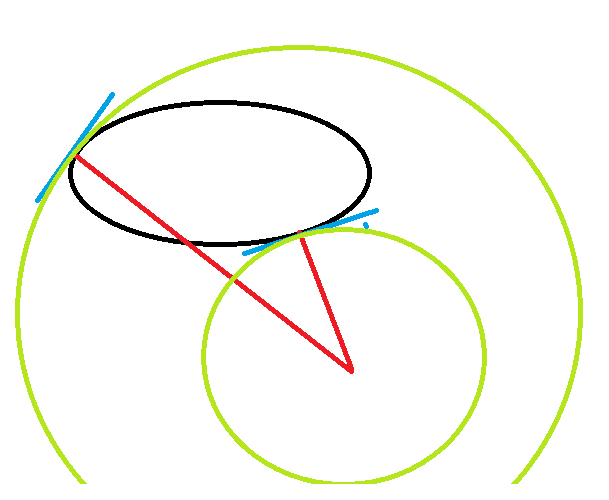
When do two ellipses overlap/intersect

Image
See also here A general rotated ellipse is \(f(x,y) = a x^2+2 b x y+c y^2+d x+e y - 1\) = X.M.X Nearest point (x,y).(df/dx, df/dy) = 0. Let this point be (X1,Y1) and (X2,Y2). X1^2+Y1^2 = R1^2  Therefore a circle radius between R1 and R2 intersects. A circle of radius >R1 overlaps. We need to find the relationship between roots of two quadratic simultaneous equations and their coefficients. It intersects a circle of radius 1/C if (x1^2+y1^2-1/C)(x2^2+y2^1-1/C)<0 or: (9*e^4+18*d^2*e^2-24*c*e^2+24*a*e^2-96*b*d*e+9*d^4+24*c*d^2-24*a*d^2+16*c^2-32*a*c+64*b^2+16*a^2)* C^2 + (-6*a*e^4+12*b*d*e^3-6*c*d^2*e^2-6*a*d^2*e^2+8*a*c*e^2-16*b^2*e^2-8*a^2*e^2+12*b*d^3*e+16*b*c*d*e+16*a*b*d*e-6*c*d^4-8*c^2*d^2+8*a*c*d^2-16*b^2*d^2)* C +a^2*e^4-4*a*b*d*e^3+2*a*c*d^2*e^2+4*b^2*d^2*e^2-4*b*c*d^3*e+c^2*d^4    <   0 (which is a 6th degree polynomial) To convert this to the case where we have two ellipses we need to transform: a*x^2+2*b*x*y+c*y^...

Single-state multiple-head Turing machines

We can create Turing machines with no internal states if we have multiple heads. The question is how many colours do we need? Assuming the 3 state, 2 colour Turing machine is the simplest. For 1 head: Not Possible with 1 state For 2 heads: <=6 colours For 3 heads: <=6 colours (4?) .... For 2 colours: >=2 heads ... For 6 colours: 2 heads For example this is Universal: 0101001001001[010]00101010 0101010001010[110]11010100 0101110000000[111]10101010 But is this? ( 4 colours, 2 heads )? CTAGAGCATGC[CGT]CGACTCAG Or equivalently this? 100101110[10]10101010 001011100[11]10100101 Restricing the idea so that the ends must be repeated symbols. Then the (6,4) is the simplest which corresponds to 2 heads with 24 colours . So at least ABCHSADBJSADHSA[CX]ADBSADBSAHJDS Can be made Universal using only 24 letters of the alphabet. Using the more tighter idea of a Turing machine without repeating patterns at the ends. Using (2,4) Turing machine then...

Diffeormophism Invariance

Lets assume we have a diffeomorphic invariant action with: Scalars  Φ , Vectors A, Fermions  Ψ  and Gravitinos X. And dilatons c. Then we have terms: (e^8) ∂ Φ ∂ Φ (e^3) Ψ ∂ Ψ (e^12)( ∂ A ∂ A+A^4) c^2(e^9) X ∂ X c^2(e^12) ∂ e ∂ e m Ψ* Ψ Each term must equal -4. Conformal weights [c] = 5/3 [e] = -2/3 [ X ] = -7/6 [A] = 1 [ Ψ ] = -3/2 [ Φ ] = -1/3 [m] = -1 Interaction weights = 2-|spin|

First Principles

Particles from First Principles Introduction The idea behind the following is to put the discrete indices on the same footing as the continuous variables. With nothing more complicated than momentum conservation and charge conservation we shall attempt to deduce the Standard Model. Definitions Let define a field  Φ ( k , N ) where k  is a 4-vector of continuous values and N is a vector of discrete values of unknown (or even infinite) length. k shall be called the momentum vector and N shall be called the charge vector. The vectors N  could, for example, be vertices on a polytope or lattice with the property that each vector is the sum of at least one pair of other vectors. Neutral Fields Now we must also define some more (vector) functions at the special points where k =0 or N =0. Where there is no momentum of no-charge. The neutral fields are given by the Z functions, which can be contracted with a charge: Z ( k , 0 ). N The sigma functions ar...

Hyper-determinant

Hyper-determinant With the Levi-Civita symbol we can define a determinant: ε^{a1,a2,a3,...} = 0 if any 2 of the indices the same. (1 otherwise) (Also, antisymmetric) Determinant of a 2-tensor is: det_2(A) = ε^{a}ε^{b}A^{a1,b1}A^{a2,b2}A^{a3,b3} .... We can define f^{a1,a2,a3,...} = 0 if any 3 of the indices the same. Determinant of a 3-tensor is: det_3(A) = f^{a}f^{b}f^{c}A^{a1,b1,c1}A^{a2,b2,c2}A^{a3,b3,c3} .... In the case where it is a 2x2x2 symmetric 3-tensor this should give the discriminant of a cubic. Let g_n{a1,a2,a3...} =0 if any no n of the indices are the same. Determinant of a n-tensor is: det_n(A) = g_n^{a}g_n^{b}g_n^{c}...A^{a1,b1,c1,...}A^{a2,b2,c2,...}A^{a3,b3,c3,...} .... Properties Assuming all components of A are independent (not true for symmetric tensors!). det_1( A ) = 0 by definition. d/dAin d/dAim det_2( A ) = 0 d/dAin d/dAim d/Aio det_3( A ) = 0 Inverses We can generalise the definition of an inverse for a 2-tensor: ...