Posts

Four Generations under SU(8)

Image
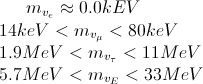
Four Generations under SU(8) This is exploring if we can fit four generations of particles under SU(8). We find that we this gives a way to predict the fourth generation masses and also predict the neutrino masses. Here is a link to it: Four Generations under SU(8) Perhaps in a few years the LHC will prove this right or wrong.

N=8 Supergravity + 48 x N=4 Super-Yang-Mills = E8 Symmetry?

It occurs to me there is a way in which this theory can be extended to give an even more symmetric theory which would have E8 symmetry. The way this would work would be to couple 48 N=4 Super Yang-Mills fields to N=8 Supergravity. (These 48 fields might form a gauge group of SU(7) or O(10)xSU(2) or SU(5)xSU(5) for example - which, coincidentally, are quite nice for phenomenology.)  The resulting theory would have 256+16*48 = 1024 = 2^10 massless fields (the same as a hypothetical N=10 theory but with all spins<=2).  This theory would have 56+4*48 = 248 massless spin 1/2 fermions of each helicy suggesting an E8 representation may be possible. Pure N=8 Supergravity had 56 massless spin 1/2 fermions (suggesting an E7 representation). This theory is midway between pure N=8 Supergravity and the lowest energy limit of Heterotic String Theory in 4 dimensions (which has an E8xE8 Super Yang-Mills gauge group). Other interesting theories might be found by adding one of ...
Vortex Solution to Navier Stokes Equations

Image
This is a solution I found to the Navier Stokes equations . It uses the flow lines of the Hopf Fibration (which is basically just a way of covering the entire 3D space in circles). The flow lines can be seen in this image below: You can see my paper here. Solution to Navier-Stokes equation . Unfortunately I won't get a million pounds for winning the Clay Millennium prize because this is a compressible not incompressible solution. :( Oh, well. Nice try! I think it's pretty nice anyway. :) Also it uses the nice identity: which paramaterizes the Pythagorean quadruples!

How to grow a digital computer

This is my theory of how memory works in the brain. The idea is that each neuron in the brain has a memory address encoded in a chemical form like DNA. This way the brain could function much like a random access computer. Here is a link to the paper. Digital Model of Cell Identity